Olivier Dumont on Transforming Articles into Podcasts with Tipp
The founder of Tipp on why he built a personalized podcasting app, how it redefines staying informed, and what success means for his company.
Drowning in unread articles and infinite browser tabs, Olivier Dumont saw a problem—and a solution. As a podcast enthusiast, he wondered if AI could convert any article, email, or research paper into a personalized podcast. That concept evolved into Tipp, a programme that converts text to audio so users can keep informed while on the road. Dumont discusses how his expertise in data science influenced Tipp, why personalization is important, and how AI is transforming the way people consume information.
Olivier Dumont answered AIPressRoom's questions in writing; the answers are published as received.
What inspired you to create Tipp, and how did you identify the opportunity for personalized podcasting?
I'm on the road quite a bit, so I'm a big fan of podcasts and audiobooks on the go to optimize my trips and commutes. However, there's only so much I find really interesting to listen to. I'm also that person who always has a couple of browser tabs open for stuff 'I will read later'.
Putting these two things together was what got me to start building Tipp. Once I realized how useful this solution was for me, I knew it could benefit others, too. That's how Tipp evolved into the app it is today.
These days, I still use it myself to easily dive deep into research papers, specific news topics or newsletters—things I would otherwise never find the time for reading.
What aspects of your personal or professional background uniquely prepared you for building Tipp?
I've been in data science and engineering for the past decade, a field that evolves incredibly quickly. Over the years, I've developed two guiding principles: don't reinvent the wheel and always start with simple, focused solutions.
Tipp reflects these principles. It leverages existing technologies to provide a streamlined, practical solution for a niche audience. By starting with this specific focus, we were able to gather invaluable feedback early on. This feedback shaped Tipp's development and ensured it directly addressed real-world challenges.
During Tipp's early stages, what was the toughest feedback you received, and how did it influence your approach?
Oh, it's like a reader app?
Tipp is there to help users streamline the vast amounts of information that get thrown at them online all the time. It can bookmark pages for later, set up custom mailboxes, and follow up on certain news topics and RSS feeds. With all that, it then provides a synthesized analysis for on-the-go use.
This feedback mainly showed me that it's very important to properly communicate all the features Tipp offers. It is not just a reader app but a productivity machine that helps you streamline information.
How do Tipp's mailboxes and RSS feed tracking redefine how users stay informed?
Our users typically follow up on very niche topics that are not covered in mainstream media. In the first versions of Tipp, there was still a lot of manual effort with the users. Since the updates with personal mailboxes and feed tracking, their favourite content just streams right into one place, ready to be transformed into on-the-go podcasts.
The Chrome extension allows users to 'Tipp anything.' Can you share a memorable user story where this feature made a big impact?
One example is someone who had to prepare for a business trip. They had to get up to speed by going through a bunch of documents and reports. Can't go unprepared, right?
However, as you can imagine, there was no proper time to go through all the details upfront. For that specific case, Tipp's Chrome Extension was used, as it also allowed users to upload private and sensitive documents securely.
Preparing went from something that would've taken a couple of hours of focus time to a very informative and tailored podcast for on-the-go.
I really liked this story, as it turned lost (travel) time into an opportunity. Doesn't it feel incredible to walk into a meeting fully prepared, even when you've been juggling a million other things? It is about turning that downtime into actual useful time.
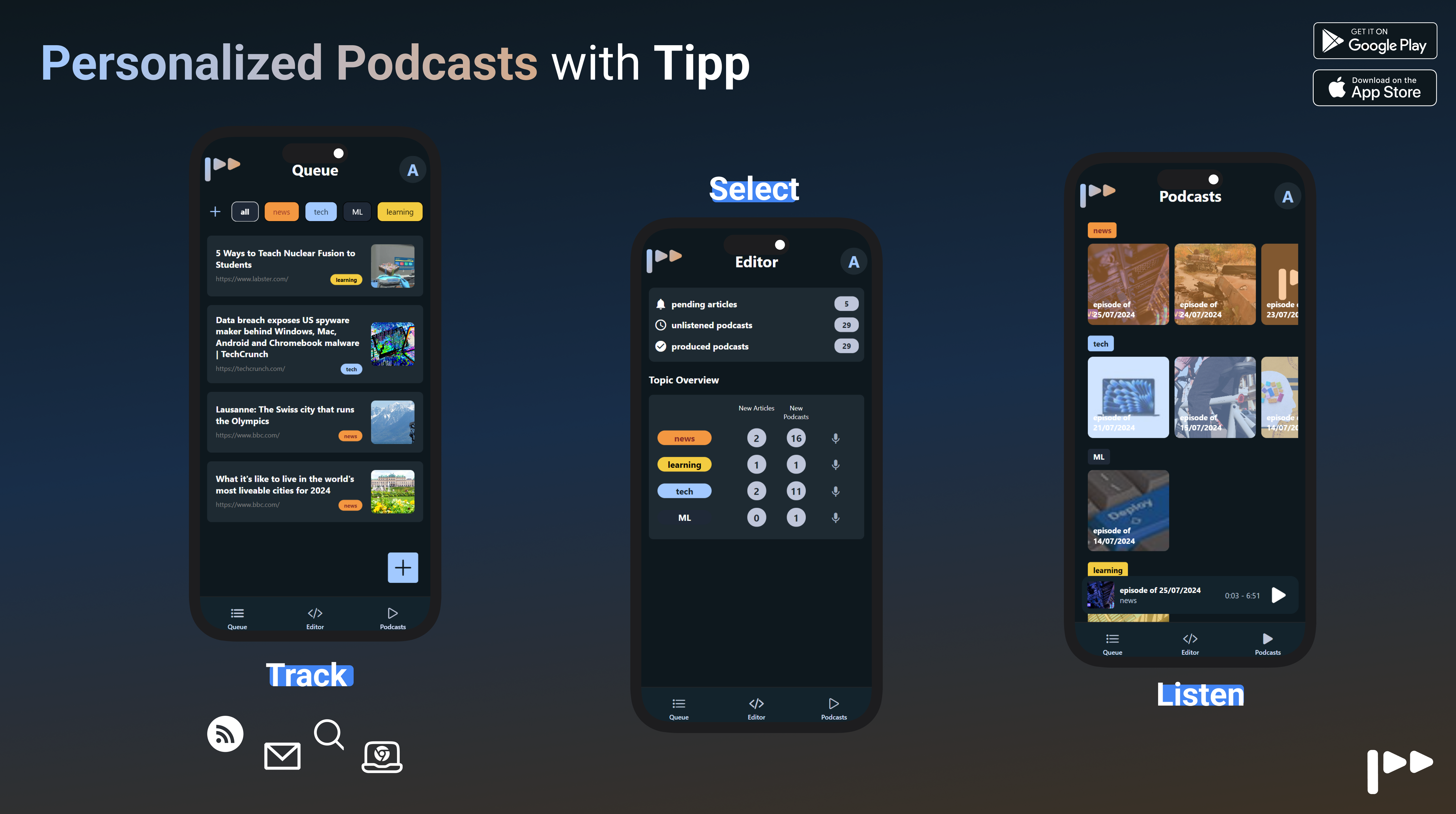
With so much content available online, how does Tipp ensure the podcasts remain highly personalized and relevant?
With Tipp, users remain the final decision-makers for the content that makes it to their podcasts. By combining human curation with AI efficiency, Tipp enables high-quality, personalized audio content. Many users note they find it easier to assess the quality of information when hearing it rather than reading it.
What steps has Tipp taken to address data privacy and build trust with users?
Protecting our users' data and privacy is at the core of what we do. Our platform deals with personal and sensitive content that users entrust to us to create podcasts.
First and foremost, all user data is protected through robust encryption, during transit and at rest. This means that whether you're sharing an email or bookmarking a page, it's safeguarded behind industry-standard security protocols.
Second, we have a minimal data collection protocol. This means we only gather the information we need to provide our service. Your information is yours, and we don't monetize it in any way beyond enhancing your experience.
Finally, we give our users full control. Users decide what content they want to add to their podcasts, and they can delete any data at any time.
As AI continues to evolve, how do you envision Tipp's role in shaping the future of personalized content consumption?
We've been moving to hyper-personalisation and AI-generated content for a while. I definitely understand the scepticism around the filter bubble and fake news, but I believe keeping humans in the loop and staying critical will go a long way already.
With Tipp, users select the content they care about most, and our AI transforms it into engaging personalized podcasts. It's a collaboration. Humans provide the quality, and AI handles the efficiency.
For me, using audio has always felt like a hack. You can learn while doing other things. With Tipp, this idea scales into hyper-personalized content that adapts to your needs. Looking ahead, we see tremendous potential in improving the depth and flexibility of the insights and analysis Tipp delivers. Imagine audio that not only informs but also anticipates the nuances of your preferences, helping professionals stay ahead in ways that feel effortless. We're just getting started.
What has been the most rewarding and challenging part of your journey in creating Tipp?
One of the most rewarding and challenging aspects has been keeping up with the rapid pace of AI developments. The landscape in which Tipp operates changed drastically since its inception. Leveraging these evolving technologies is exciting, but it also comes with the challenge of applying them in a user-friendly and reliable manner.
Looking back, is there a decision or approach you would take differently in building Tipp, knowing what you know now?
So far, there aren't any major decisions I would change, fortunately. That's largely because Tipp isn't the first product I've built. A lot of mistakes and learnings happened along the way.
Mistakes are part of the process. For me, it's less about avoiding them and more about managing and resolving them effectively.
What does success mean to you personally, and what are your long-term aspirations for Tipp?
I love what I do, but I know first-hand that it's important to have a healthy balance in everything that you want to do and achieve. To me, success is when I succeed in guarding and maintaining that balance. I'm not saying I always get this right, but when I do, it feels incredibly rewarding.
For Tipp, success means making a real-world difference in how people manage information overload. I hope it becomes an indispensable tool for people who want to hack their schedules. Long term, I'd love Tipp to evolve into a true personal assistant for your knowledge - your 24/7 AI-powered research and editorial team helping you stay on top of your game.
What does a typical day look like for you as Tipp's founder?
A mix of product development, marketing, and everything in between. No two days look the same. Some days are heavily focused on refining Tipp's features, gathering user feedback, and planning. Other days involve thinking about growth: marketing strategies, partnerships, and getting the word out. It's always about balancing building the right product with making sure people know about it. So, in short: very varied never boring!
About
- Interviewee
- Olivier Dumont · Founder
- Company
- Tipp
- Sector
- Consumer & Creative
- Topics
- consumer-ai · personalization · podcasts · read-it-later · text-to-audio