Signal
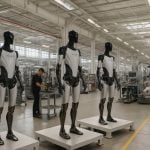
Persona AI and the State of Louisiana have launched a joint pilot program to deploy humanoid robots at SSE Steel Fabrication, an active heavy-industry facility in St. Bernard Parish. The trial focuses on training robots for welding and fabrication tasks in environments designed for humans, rather than retrofitted for automation.
Backdrop
This public-private collaboration marks a departure from typical laboratory testing.
- Ruggedized Design: Persona AI’s platforms are engineered to navigate uneven terrain and use existing industrial tools, specifically targeting labor-intensive sectors like shipbuilding and steel.
- State Support: The initiative is coordinated through Louisiana Innovation, aiming to position the state as a testing ground for embodied AI in manufacturing.
- Human-Centric Roles: The pilot emphasizes “augmentation,” allowing experienced tradespeople to transition into supervisory roles while robots handle high-risk or repetitive tasks.
Why it matters
The Louisiana pilot represents the “Hard-Industry Validation” required for humanoid scaling.
- Breaking the “Clean Room” Bias: While the Hyundai Atlas deployment focuses on highly controlled automotive lines, the Persona AI pilot tests “rugged AI” against the unpredictable variables of heavy metal fabrication.
- State-Led Infrastructure: Louisiana is treating “Physical AI” as a workforce modernization tool, similar to how the NYGC carbon-negative factory treats energy—as a sovereign asset that can attract high-tech manufacturing.
- Video-Driven Skill Transfer: Success in welding and fabrication tasks will depend on the robot’s ability to process real-world spatial data, a capability accelerated by foundation models like the 1XWM world model.
Industry Impact
- Workforce Re-skilling: By focusing on “augmentation,” Persona AI avoids the immediate labor friction seen in other sectors, providing a blueprint for public acceptance of humanoid labor.
- Standardizing “Rugged AI”: If Persona AI can succeed in a steel shop, it sets a performance ceiling for humanoids in unstructured industrial environments.
Counter-signals & Friction
Despite the enthusiasm, the pilot faces several “real-world” stressors:
- The “Welding Gap”: High-precision welding is notoriously difficult to automate due to dynamic thermal changes and material variance; there is a high risk that the “augmentation” remains limited to simple material handling for the first 12–18 months.
- Cost vs. Outcome: With no financial terms disclosed, the economic viability for a mid-sized firm like SSE Steel Fabrication remains unproven.
- Safety in Tight Quarters: Heavy fabrication shops are often cramped and hazardous; ensuring safety without “fencing” the robots (fenceless guarding) remains the primary technical hurdle.
What to watch
- Q3 2026 Performance Data: Whether Persona AI can achieve a 90% accuracy rate in complex welding tasks without human intervention.
- Expansion to Shipbuilding: Whether the Louisiana state government expands this pilot to major shipyards, indicating a larger “Blue AI” strategy.