IntelligenceDefense & Security
The Decoupling of Defense Hardware
Modern warfare is shifting from high-cost platform preservation to modular, attritable systems. Here is why procurement inertia remains the primary barrier to the goal-oriented "agentic" battlefield.
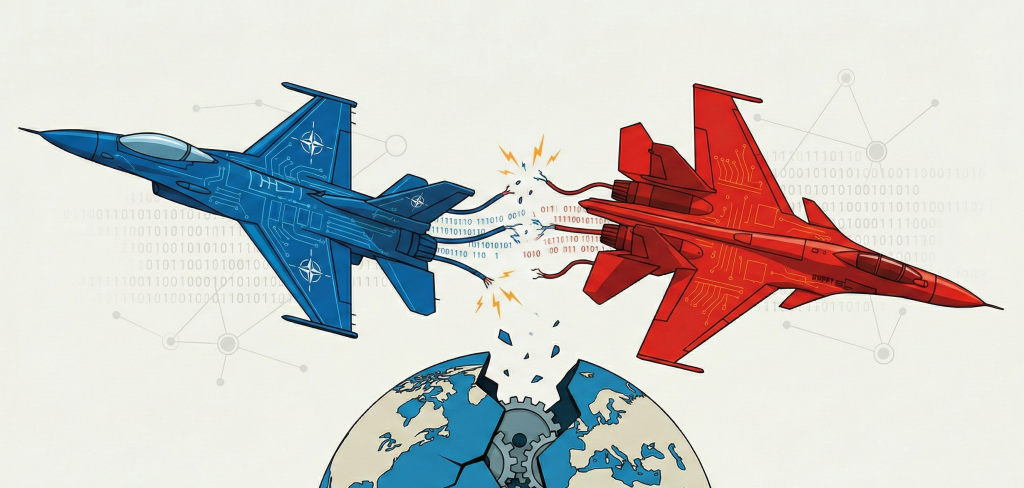
The Big Picture Global defense strategy is undergoing a fundamental structural pivot: moving away from “exquisite,” high-cost platforms toward attritable systems designed to absorb loss. This is not merely a hardware shift, but a transition in control theory. As electronic warfare makes signal denial a baseline condition, the industry is moving from instruction-oriented automation to goal-oriented autonomy.
The Breaking Point: The One-Pilot Problem
Current drone operations are limited by a scaling bottleneck where one pilot is tethered to one system. This manual control model is a legacy constraint that prevents mass deployment.
Alexander Le Maitre, founder of Seeing Systems, locates the primary friction not in the hardware, but in this one-pilot bottleneck. He contends that the solution lies in Mission Command, turning command into a software abstraction where the operator defines intent—such as “patrol this area”—and the autonomy layer handles the execution mechanics.
The Structural Friction: Procurement Inertia
Despite the clear tactical advantages of attritable systems, the primary barrier remains institutional. Defense procurement cycles are still designed around long-term, fixed-requirement capital assets. There is a fundamental tension between the speed of software iteration and the inertia of multi-year acquisition processes.
For the “agentic” battlefield to become a reality, military organizations must overcome the “control fear” inherent in autonomous systems. Safety and accountability frameworks have yet to catch up with platforms that can re-plan their own geometry in real-time under jammed conditions. Transitioning to this new model requires not just new hardware, but a complete overhaul of how the state buys and trust-verifies autonomous assets.
The Breaking Point: The One-Pilot Problem
Current drone operations are limited by a scaling bottleneck where one pilot is tethered to one system. This manual control model is a legacy constraint that prevents mass deployment.
The structural solution is the shift to Mission Command. In this model, the operator defines intent—such as “patrol this area”—while the system handles navigation, deconfliction, and execution autonomously. By turning command into a software abstraction, a single operator can supervise a fleet, moving the bottleneck from human dexterity to system-level coordination.
The Bottom Line
By 2030, the primary metric of defense effectiveness will shift from platform survivability to mission reliability in aggregate. Success will be defined by the ability to field composable systems that evolve under combat timelines. Procurement departments that fail to adapt to this “software-first” reality will find themselves holding expensive, obsolete platforms in a battlefield defined by scale and loss.
The fleet is becoming the operating system.